
7 Signs Your Small Business Marketing Is Wasting Money And How a Marketing Audit Finds Them
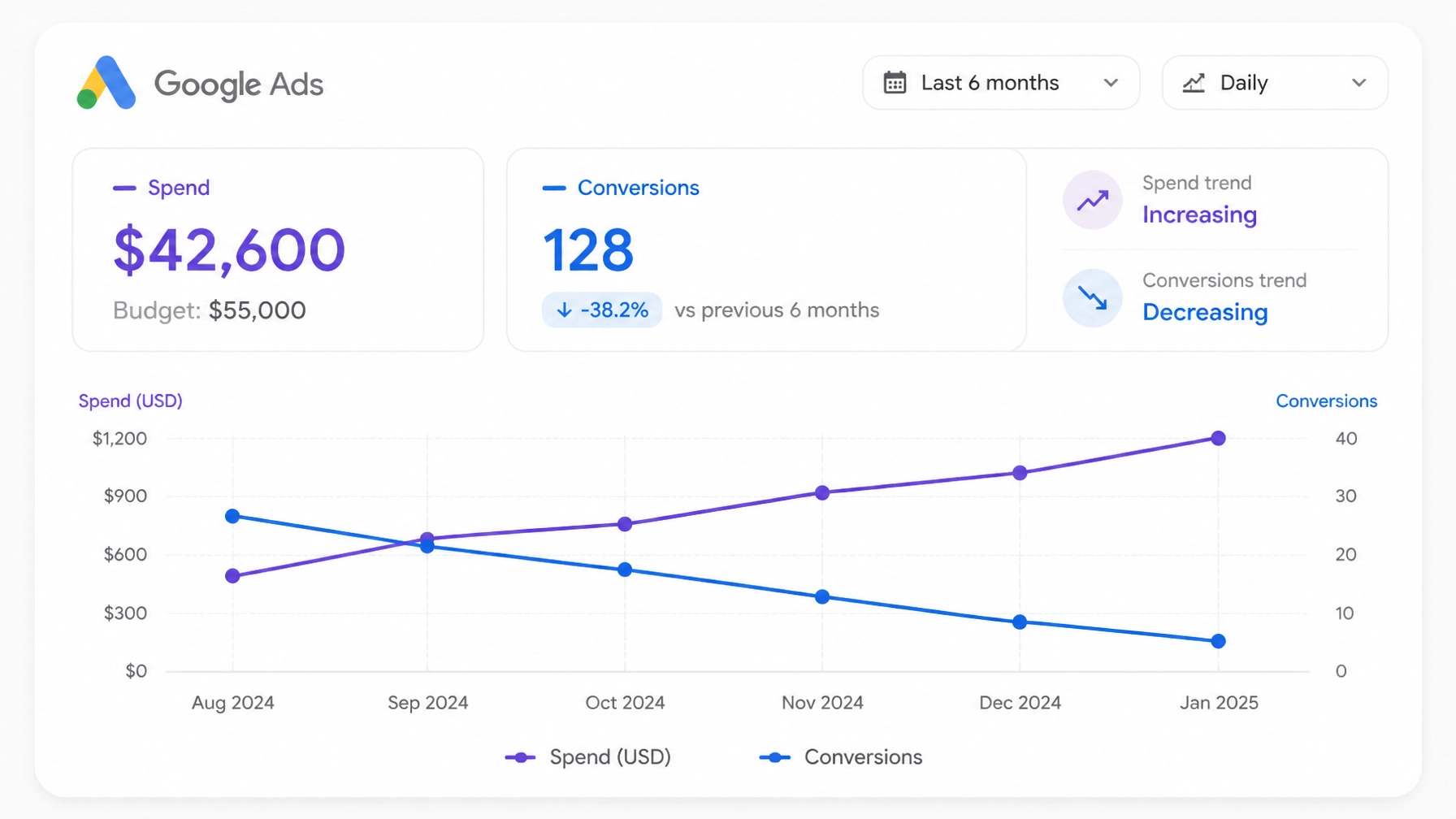
Marketing waste is not always obvious.
You may be running Google Ads, posting on social media, publishing content, and paying for marketing tools every month. On paper, your business is active. But can you clearly explain which activities are generating qualified leads, booked appointments, sales, or revenue?
If the answer is no, your small business may not have a marketing effort problem. You may have a clarity and accountability problem.
A practical marketing audit can show you where your budget is working, where it is underperforming, and where money should be reinvested for stronger results. At Lead Maze, we help small and mid-sized businesses review their website, SEO, paid advertising, social media, messaging, and lead-generation process through one connected strategy.
Here are seven warning signs that your marketing budget may not be working as hard as it should.
1. You cannot connect marketing spend to business results
Marketing metrics can look positive while your business results remain flat.
You may see clicks, impressions, followers, or website visits increasing. But those numbers do not automatically mean more customers. If you cannot connect a campaign to a qualified lead, phone call, form submission, sale, or booked job, it is difficult to know whether the investment is justified.
Ask yourself:
- Which campaigns generated your last five qualified leads?
- Which channels produced new customers?
- Can you track calls and form submissions back to a campaign?
- Do your reports show revenue or only activity?
- Can you explain what each marketing expense is expected to produce?
A marketing audit maps your spending to measurable outcomes. We review analytics, advertising platforms, website conversions, and available CRM data to identify gaps between activity and results.
That gives you a clearer basis for deciding what to keep, fix, pause, or scale.
2. Your qualified lead flow is flat or declining
Your total lead count is not the only number that matters. Lead quality matters just as much.
If your business is receiving more inquiries but fewer serious prospects, your marketing may be attracting the wrong audience. You may be paying for traffic from people outside your service area, below your target budget, or with no genuine need for your product or service.
Compare your results over the last three to six months:
- Total leads
- Qualified leads
- New customers
- Revenue from marketing-generated leads
- Marketing spend
- Cost per qualified lead
If spending rises while qualified leads and customers remain flat, your budget may be funding motion instead of progress.
Our lead-generation services focus on finding the right prospects and improving the path from first visit to meaningful conversation. An audit helps determine whether the issue is targeting, messaging, website conversion, follow-up, or channel selection.
3. Your cost per qualified lead keeps increasing
Cost per click is not the same as cost per customer.
A campaign can generate inexpensive clicks and still produce poor business results. For a small business, the more useful calculation is usually:
Total channel spend ÷ number of qualified leads
You can also calculate cost per acquisition:
Total channel spend ÷ number of new customers
Track these numbers by channel and campaign. Then look for trends.
Rising cost per qualified lead may point to:
- Weak keyword targeting
- Poor ad relevance
- Increasing competition
- Low-converting landing pages
- An unclear offer
- Inaccurate conversion tracking
- Slow or inconsistent follow-up
- Budget allocated to low-intent traffic
Paid search should not be treated as a set-it-and-forget-it channel. Lead Maze paid search marketing includes keyword research, ad optimization, landing page review, negative keyword management, conversion tracking, and reporting.
The goal is not to buy more clicks. The goal is to make more of the right clicks count.
4. Your tracking and attribution are incomplete
How do you know where a new lead came from?
If your answer is “the customer told us they found us online,” you may need stronger tracking. Without reliable data, business owners are forced to make budget decisions based on memory, assumptions, or the most visible platform report.
A marketing audit reviews whether you have:
- GA4 configured correctly
- Google Search Console connected
- Conversion actions set up in advertising platforms
- Call tracking or call-source reporting
- Form submission tracking
- UTM parameters for campaigns
- CRM attribution
- Consistent reporting across channels
Tracking does not need to be complicated. It does need to answer practical questions.
Which campaign generated the lead? Which landing page converted? Which source produced a customer rather than an unqualified inquiry?
Better attribution helps you eliminate waste and reinvest in the channels that show repeatable potential.
5. Your ads are broad, poorly targeted, or sending traffic to weak pages
Broad targeting can spend your budget quickly.
For search campaigns, problems may include loose keyword match types, irrelevant search terms, weak negative keyword lists, or ads that do not match what the customer is looking for. For social campaigns, the audience may be too broad or disconnected from your actual buyer.
Even well-targeted traffic can underperform if the landing page is difficult to use or does not provide a clear next step.
Review the following:
- Search terms triggering your ads
- Geographic targeting
- Audience settings
- Negative keywords
- Ad-to-landing-page relevance
- Mobile page speed
- Form length
- Call-to-action clarity
- Conversion rate by landing page
A marketing audit looks beyond the ad account. It examines the full customer journey, from targeting and creative to the website experience and follow-up process.
Sometimes the right answer is not to cut advertising. It is to optimize the conversion page receiving the traffic.
6. Your budget is spread across too many channels
Should your business be active on every platform?
Usually, no.
Small businesses often have limited time, staff, and budget. Spreading those resources across search, social media, display advertising, print, sponsorships, email, content, and multiple software tools can create a lot of activity without enough momentum in any one channel.
This does not mean every channel is ineffective. It means every channel should earn its place in your strategy.
We may recommend prioritizing:
- One or two high-intent acquisition channels
- A stronger local SEO foundation
- Website improvements that increase conversion rates
- Content that answers customer questions
- Retargeting for visitors who did not convert
- Social media platforms where your customers are active
- Lead follow-up improvements
Our SEO and content marketing services can help reduce dependence on paid traffic over time by building organic visibility and useful content. SEO is not an instant replacement for every paid campaign, but it can become a sustainable source of qualified traffic when supported by the right strategy.
7. You keep paying for campaigns and tools out of habit
Marketing expenses often continue simply because no one has reviewed them recently.
A campaign stays active because it has always been active. A software subscription renews because no one is sure who uses it. A social media package continues even though it has not generated a meaningful inquiry. An old landing page remains live despite poor performance.
Look for:
- Campaigns with no recent optimization
- Duplicate software subscriptions
- Tools no one actively uses
- Channels with no defined objective
- Content that receives traffic but creates no action
- Advertising audiences that have not been reviewed
- Recurring expenses that do not appear in performance reports
The answer is not to cut everything. The answer is to evaluate every expense against a clear business purpose.
A practical small business marketing strategy should make budget decisions easier, not more confusing.
How a marketing audit finds inefficient spending
A useful audit is more than a list of platform statistics. It should provide a prioritized plan.
1. Inventory every expense
We review the last 60–90 days of marketing activity, including:
- Paid search and social advertising
- Agency or freelancer fees
- Website and hosting costs
- Marketing software
- Content production
- Social media management
- Print, events, and sponsorships
- Email and automation tools
2. Review performance by channel
We examine spend, reach, traffic, leads, conversion rates, lead quality, and customer outcomes where data is available.
3. Identify the source of underperformance
The problem may be poor targeting, weak messaging, technical issues, a low-converting website, inaccurate tracking, or a mismatch between your audience and offer.
4. Prioritize recommendations
Not every improvement has the same potential impact. We organize recommendations into practical categories:
- Fix now: Tracking errors, wasted keywords, broken forms, or major website issues
- Improve next: Landing pages, ad copy, SEO structure, content, or follow-up
- Test carefully: New channels, audiences, offers, or creative concepts
- Scale later: Campaigns and channels with strong, repeatable performance
5. Build a reinvestment plan
The goal is not simply to spend less. The goal is to spend more intelligently.
That may mean moving budget from low-quality paid traffic into high-intent search, website conversion improvements, local SEO, content marketing, or a more focused lead-generation program.
A marketing audit should give you confidence: not pressure
You do not have to buy additional services after an audit. A strong audit should be useful whether you implement the recommendations yourself, work with another provider, or ask Lead Maze to help with execution.
At Lead Maze, we focus on practical recommendations for small and mid-sized businesses. We consider your goals, industry, competition, budget, internal resources, and current performance before recommending a path forward.
You receive:
- A clear report in plain English
- Website and conversion analysis
- SEO performance review
- Paid search and social advertising review
- Organic social media evaluation
- Brand and messaging assessment
- Competitive benchmarking
- Prioritized next steps
- Optional ongoing consulting and implementation support
Stop guessing where your marketing budget is going. Remember, that wasteful spending is solvable when you can see it clearly.
If your qualified leads are declining, your cost per lead is rising, or your marketing reports do not connect activity to revenue, a marketing audit can provide the clarity you need to make better decisions.
Contact Lead Maze to discuss your current marketing performance and identify where your budget can work harder. We will help you assess what is working, eliminate unnecessary waste, and build a more focused small business marketing strategy designed for measurable, sustainable growth.